A Feast of Friendship: Ruth Hayhoe’s Homecoming in Hong Kong
(and Her New Book on Christian Universities in China)
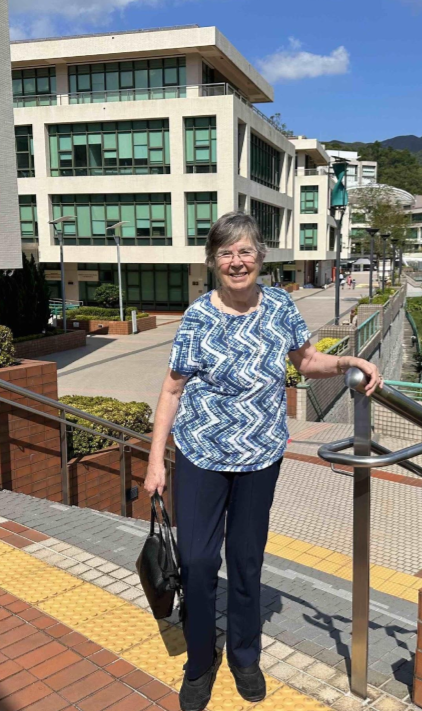
Dr. Ruth Hayhoe is a GSC board member and a professor at OISE, the Ontario Institute for
Studies in Education. We have written on her adventurous biography here and here, and we
know the adventures still continue. From November 18 -28, 2023, she returned to what
she calls her “second home” in Hong Kong where she lived for almost two decades, as
a young teacher from 1967 t0 1978 and then as the second Director of the Hong Kong
Institute of Education, now the Education University of Hong Kong (EdUHK) from 1997
to 2002. In between she had shorter appointments in Shanghai and Beijing, also visited
Chinese universities every year as part of a range of collaborative projects supported by
the World Bank and the Canadian International Development Agency. This trip was a
whirlwind tour that included visits to many of her old haunts, including:
– The Education University of Hong Kong (EdUHK), where she gave a lecture
entitled “The Teacher in Chinese Culture: Reflections on a Lifetime of Personal
Encounters.”
– Lingnan University, where she talked about the Contribution of Translation to
Cross-Cultural Communication
– The Comparative Education Centre at Hong Kong University, where she spoke
on the topic of “East-West Cross-currents in Higher Education.”
– The School of Education at the Chinese University of Hong Kong (CUHK), where
she engaged faculty and students on “The Ups & Downs of Doctoral
Supervision.”
– The Divinity School at CUHK offered a conversation around her new book.
– The University of Macao, visiting students and former colleagues
– The University of St. Joseph, also in Macao, where the focus was on the
amazing legacy of the 16 th century Italian Jesuit missionary Matteo Ricci and his
Chinese colleague Xu Guangqi.
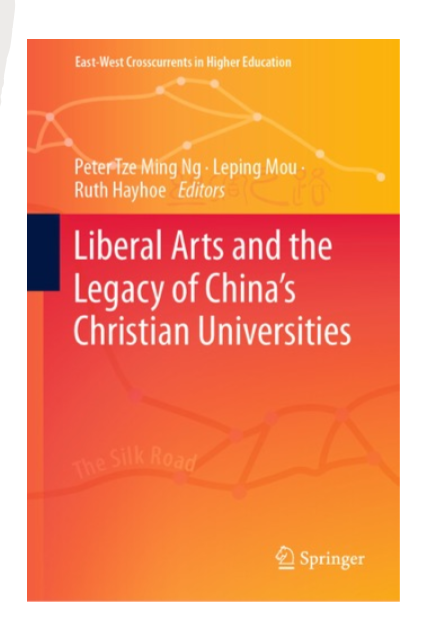
The trip comes shortly after the release of a new co-edited volume she launched,
Liberal Arts & the Legacy of China’s Christian Universities (Springer 2023). This
collection of 13 articles in English translated by Ruth investigates the history, sociology,
and educational philosophy of China’s historic Christian universities. These articles by
current historians and sociologists in China argue that despite the Cultural Revolution
and current restrictions on religious teaching, the legacy of these universities continues
to influence the wider world of education in China, as their liberal arts approach fosters
not only connections to the Western liberal arts tradition, but also fruitful engagement
with the history, philosophy and religion of China.
Christian educational resources focus on such matters as moral formation, community
service, and the ideal of global citizenship that engages the whole person, including
character development. While the teaching at these institutions was largely done by
foreigners in the earliest days (the late 19th century), and there were some
incompatibilities of the Western canon with the Chinese worldview, this book “re-tells the
Chinese side of the story.” It chronicles the role of Chinese Christian educators, the turn
to serve local social and economic needs, and the Chinese character of most of the programs and scholarship, as well as the revival of Chinese classical architecture on the
campuses. In all, the story is one of increasing Chinese ownership and integration.
Sadly, these universities were taken over by the government some seven decades ago,
and Chinese universities turned to training in more specialized and professional
programs under Soviet influence, especially in STEM fields (science, technology,
engineering and math). The legacy of these Christian universities, however, lives on as
the liberal arts model has come back with China’s opening to the world in the 1980s and
1990s and had a renewed influence on higher education in China with its emphasis on
“greater creativity, critical thinking, and service-mindedness.” This inclusion of the arts
and humanities can also be seen in many universities in Hong Kong, Macao and
Taiwan, and has been the vision of organizations like the United Board for Christian
Higher Education in Asia, which was founded to support Christian universities in China
in 1922, and then moved to support higher education all over Asia from the 1950s. It
might be seen part of a broader global movement for Christian higher education that
includes GSC and the Society of Christian Scholars. This means, as Tong Wing-sze
says in the foreword, an education “embracing integrity, compassion, and spirituality, so
as to nurture our college students in whole-person education.” (xiii)
In the recent anthology on this approach to education, The Liberating Arts: Why We
Need Liberal Arts Education (Plough 2023) the editors explain that “liberated from
complacency and from the confines of our respective disciplines and specializations, we
were liberated for friendship and the possibilities of intellectual community… to foster
liberality or generosity, the dispositions that make friendship possible” (2). To be
educated means to understand physics, but also to know some poetry and creatively
tussle over the ethics of both with your friends, some coffee, and a deep desire to serve
the wider world.
We have seen the photos from Ruth Hayhoe’s recent visit to Hong Kong and Macao,
and we see the names in this new collection of essays on liberal arts in China, and we
see the very incarnation of this kind of generous friendship at work. These are
relationships formed around conversations that matter—about what it means to be a
human being, how to address the deep social, economic and environmental problems
that face us all, and how to cultivate personal disciplines that build our character, solidify
friendships, and connect us to God.
When we lose the liberal arts educational approach and turn education into purely
scientific or professional training, we lose a very significant part of who we are as
human beings. We lose contact with our cultural history, the beauty of art and literature,
and the need to have cross-cultural conversations that will show our blind spots and the
genius of other peoples. We also lose a vital connection to God, the one who provides
the “unity” in the “diversity” of the many specializations in our revered universities.
“No tool is omnicompetent” is writer David Epstein’s refrain in Range: Why Generalists
Triumph in a Specialized World (2019). We might add, no single discipline comprises a
full university education.
Religion is one example of a discipline falling on hard times, along with the rest of the
humanities. But if religion is not included explicitly in higher education, it will operate
clandestinely, as no education can avoid a framework for learning, the assumptions that
come with a worldview. Questions like: what is the purpose and goal of education? Such
important commitments remain immensely influential, even if not named outright. The
liberal arts approach allows a university to explore it’s own commitments and compare
and contrast them within the wider global academy, and that is a vision worth all our
best efforts.
That is the effort that Ruth Hayhoe has put into her whole vocation, from her undergrad
degree in the Greek and Latin Classics, to learning Cantonese and Mandarin in Hong
Kong, and then with graduate degrees from London, teaching comparative educational
philosophy over the last 35 years. All this, and so many friends to cherish.
Ruth’s co-edited book will be launched at the annual conference of the Comparative
International Education Society in Miami this year, March 11-14, 2024.