Global Scholars Canada Impacts Global Conference
by Shiao Chong, Associate Director
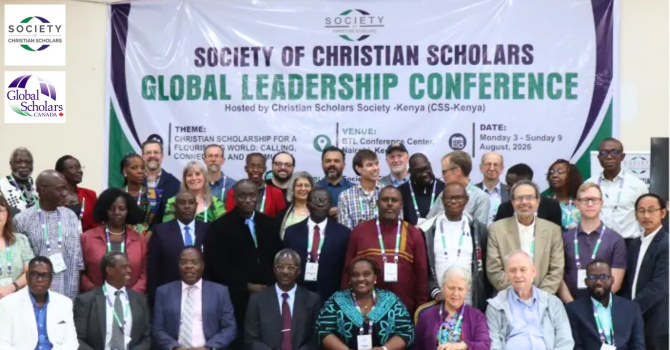
The first ever Society of Christian Scholars’ (SCS) Global Conference was held recently in Nairobi, Kenya on August 3-9, 2026. Global Scholars Canada (GSC), a long time partner of the SCS, made a significant contribution to the conference, with three of our scholars – J. Richard Middleton, Stephen Ney and Yawo Kobara – each giving presentations along with Executive Director Peter Schuurman. Schuurman was also part of the SCS’s leadership council as well as the team that planned and organized the conference, which brought together about 50 scholars from 23 different countries across the globe.
The aims of this first ever conference, with the theme of “Christian Scholarship for a Flourishing World: Calling, Connection, and Community,” were to evaluate mission, align leadership, strengthen a unified vision, enhance capacity for scholarship and to determine strategic priorities for the future.
Brain Drain and Justice
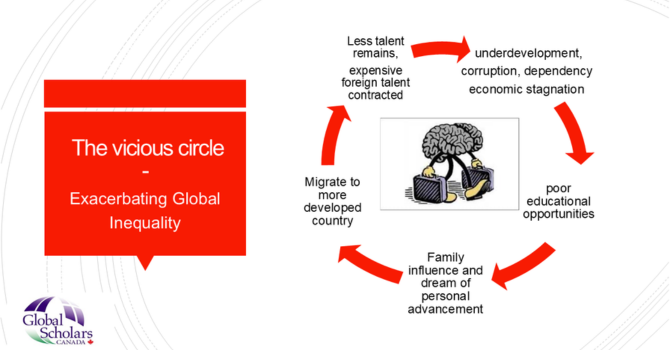
In Kenya, Schuurman gave a presentation on “Christian Scholars Without Borders: Doing Justice Where Brain Drain Depletes the Common Good.” Brain drain, defined as the migration of human talent where the net flow skews in one direction, is a justice issue according to Schuurman. It can create a vicious circle that exacerbates global inequalities. For example, as talent leaves a less developed country, it contributes to its slower development, which in turn encourages talent to seek better opportunities in more developed countries. Filling the gaps with expensive foreign talent can drain the government coffers and create a dependency mindset on the developed West.
Recognizing that the dream of personal upward mobility and security is a major fuel for the talent migration, Schuurman challenges the Society of Christian Scholars to offer a different dream, one that offers both a different motivation and a different strategy for education and scholarship. “The Society,” proposed Schuurman, “should be a place that intentionally, and actively, works against brain drain and fosters a culture of brain gain for the majority world.”
Christian scholars, Schuurman suggested, should live into the narrative of Christ who came to serve rather than to be served. The alternative dream to that of upward mobility is to go where the need is greater. Schuurman continued by encouraging the SCS to explore how it can leverage its global network to foster brain gain for developing countries. You can read Schuurman’s experience of the entire conference here: “Academic Safari, Harambi, and an Impossible Dream: Christian Scholars Gather in Kenya from Around the Globe.” And his previous blog on the topic: “Brain Drain in African Higher Education: Motivations and Methods for Bolstering African Educational Opportunities”.
Royal-Priests in a Sacred World
J. Richard Middleton presented a paper, “The Vocation of the Christian Scholar: Called to Image God,” showing how a biblical worldview clarifies the Christian scholar’s calling and purpose. Middleton explored the biblical worldview story in terms of four worldview questions: Where are we? Who are we? What’s wrong or what’s the problem? What’s the remedy or solution?
Through that exploration, Middleton argued that the Bible’s vision is of a sacred world in which all people, including those in academia, are called to serve God as his royal-priests on earth. The world, indeed all of creation, is sacred because the Bible envisions it as God’s cosmic temple with heaven as God’s “throne room” (Psalm 11:4) and the earth as his “footstool” (Isaiah 66:1). Heaven was seen as part of the created cosmos, where God’s presence is concentrated, akin to the “Holy of Holies” in the earthly tabernacle design (Exodus 26-27).
Being created in the image of God, humanity are God’s royal representatives tasked to “rule” over all living creatures and to “subdue” the earth (Genesis 1:26, 28). According to Middleton, these twin tasks, in their original context, referred to animal husbandry and agriculture, two foundational aspects of human civilization.
But humanity’s purpose is not simply royal, it is also priestly. By faithfully representing God, we were meant to extend God’s presence beyond his “throne room” or the “holy of holies” in heaven into all the earth. We are to prepare the whole earth for God’s full presence that will be realized in “a new heaven and a new earth” (Revelation 21:1). Then, God’s dwelling will be with mortals on earth (Revelation 21:3). “We are,” in Middleton’s words, “to be nothing less than God’s prism in the world, taking the concentrated light of the Creator and refracting that brilliance into a rainbow of cultural activities that scintillate, that shine with the glory of God.”

That is, ultimately, the Christian scholar’s calling as well. Christian scholars are to fulfill their calling as royal-priestly representatives of the living God in all of their academic work, from researching and teaching to mentoring students. You can also read Middleton’s account of his Kenya experience on his blog: “My Trip to Nairobi, Kenya – Conference and Safari”.
AI in the Classroom
With the growing use of AI (Artificial Intelligence) in education, Stephen Ney’s presentation in Kenya was timely and relevant. Titled, “What’s Happening Around AI? Reflections on Teaching Academic Writing at Canadian and Sierra Leonean Universities,” Ney’s paper drew on his collaboration with 15 PhD students in Sierra Leone and 12 undergraduate students in Canada. Drawing from his students’ reflections on their experience of using AI in writing assignments, Ney observed that students can easily become overly reliant on AI and that it impacts how they interact socially with others, even less interested in doing their work with other human beings.
Ney offered some theological and philosophical tools to help discern a better way to navigate AI use from a Christian perspective. He talked about the “wisdom of restraint” in AI development and use. Ney called for the need of both a biblical theology of language use and a biblical theology of work. Human words are creative and generative akin to God’s creative Word. Words also reveal what’s in our hearts. Work is valuable not only for what it produces but also for how it forms us as people. Ney emphasized that humanity are relational beings that interdepend on each other. Therefore, we should avoid using AI in ways that further isolate us from others. Finally, Ney encouraged us to draw from Indigenous pedagogies that emphasize communal learning. He cited, for example, an African pedagogy that saw the goal of education as not simply producing skilled graduates but also people of character with communal responsibility.
Ney concluded with some practical proposals for university lecturers in classroom use of AI, including to always ensure that student AI use be framed within real human conversations about its use. This makes it less likely for students to over-rely on AI and to be isolated from others.
Mapping Christian Scholarship
Statistician Yawo Kobara’s paper for the conference was titled, “Mapping Christian Scholarship: A Bibliometric Analysis.” Kobara was putting Christian scholarship itself under the microscope, so to speak. Or in this case, closer to putting it on the cartographer’s table.
Although Christian scholarship has grown and expanded in diversity, influence and global reach over the decades, not much is known about the main themes or geographic distribution of such scholarship. Kobara’s paper is the “first comprehensive bibliometric analysis of published scholarship about Christian scholarship.” Using Scopus and Web of Science online platforms for academic publications, Kobara mapped 482 publications from 1942 to 2024. Among other things, he examined authorship patterns, clusters of themes, institutional and regional contributions.
According to Kobara, the overall findings suggest that “Christian education scholarship has evolved from a largely theological and missionary enterprise into a diverse and interdisciplinary field.” While theological topics like faith formation, spirituality and religious education are still strong, Christian scholarship is increasingly addressing “issues in higher education, leadership, psychology, diversity and societal change.”
Not surprisingly, scholars and institutions, especially Christian universities, in the United States and other English-speaking countries dominate the field of Christian scholarship. However, there are growing contributions from Asia, Africa and other regions of the world. Despite this growth, the number of international research partnerships is still low. Kobara thinks that this is an area for future growth in Christian scholarship. We need to expand international collaboration, strengthen interdisciplinary partnerships, and incorporate more perspectives from underrepresented regions to enhance Christian scholarship’s global impact and relevance.
Mutual Blessing and Learning
With these four papers, along with organizational leadership involvement, GSC has made a significant contribution to the first ever Society of Christian Scholars Global Conference. But our scholars were only part of a global academic dialogue as they learned as much as they taught. It was a time of mutual blessing and learning from the 50 international scholars in Kenya.
Only one example will have to suffice. Augustin Ahoga from Benin gave a paper called “La Recherche Chrétienne dans un Environnement Hostile: Épistémologie, Institution et Identité dans les Universités Africaines Francophones. (Christian Scholarship in a Hostile Environment: Epistemology, Institution, and Identity in Francophone African Universities.)” Ahoga explored the effects of French-style, state-sponsored secularism (laïcité) in the universities of Francophone Africa. He showed how Christian scholars can become marginalized by their universities for being religious. They have difficulty accessing rigorous theological studies to grow as Christian thinkers. And they are often rejected by the emerging Panafricanist movements because of their affiliation with a foreign religion i.e. Christianity.
Ahoga’s paper underscores the importance of global Christian scholarly networks like the Society of Christian Scholars to encourage, resource and equip Christian scholars around the world. It highlights the continued necessity of GSC’s mission to mobilize Christian academics to be a redemptive gospel influence in the global world of higher education.